Sugar and Spice
When I was a little girl, I often compared myself to my older brother. It was hard not to do this. He was seven years older than myself, therefore he was smarter, bigger, funnier, more confident and more capable than I was–an ‘annoying’ little sister trailing behind him.
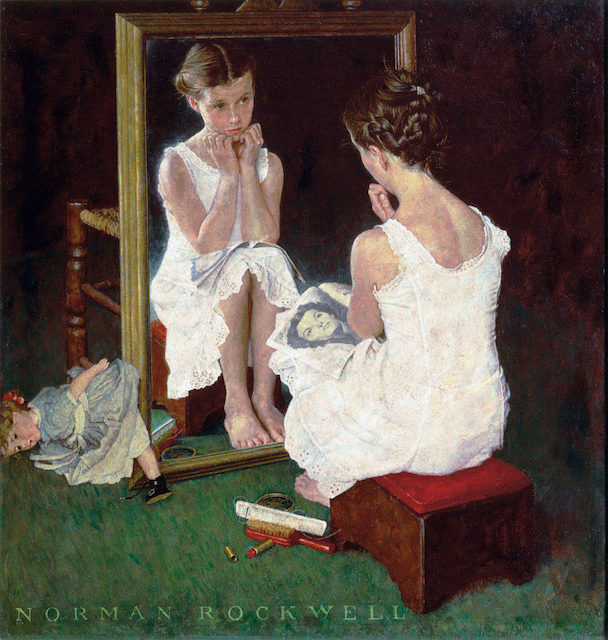
Sometimes, after being kicked out of that secret society where boyish talk and Nintendo games dazzled the eye and mind, I would sink into a bog of resentment, alone in my room. I would wish, spitefully, that I was a boy, like my brother. Then maybe I would be big and strong and capable like he was. Maybe then I wouldn’t be so alone.
One time, after I had slipped into this resentful attitude, I noticed what I can now recognize as a higher level of thought arise out of my little 7-year-old consciousness. Instead of focusing on the feeling that I would rather be a boy, and how unfair it was that I was not a boy, this thought occurred to me instead: would it REALLY be better to be a boy? Is that really true? Which is better? Being a boy or being a girl? If I could magically become a boy right now, would I honestly want to? Setting aside my angst, my little rational self began to take over and ask a serious question. It didn’t take too long to come up with an answer.
I can still remember what I pictured in my mind. I was looking down at a drawing I had recently made: on one side, there was The Princess. She was adorned with glory: a long, elegant gown, jewels, a crown, high-heeled shoes, red lips, and flowing hair. Her body contained hints of the mysterious biological finery that God himself grants in some share to all women, after the image of Eve, the pinnacle of creation. She was fascinating.
On the other side, there was The Prince. Although I liked the idea of him, and definitely wanted him in the picture, I couldn’t demonstrate anything particularly interesting about him through drawing. His clothes were drab, undecorated and dark. His figure, from what I could understand of it, was plain, boxy and undefined. I could barely maintain any interest in picturing him, with what little I understood of his anatomy. He was a place holder for something I longed to know in the far distant future. I could feel a longing for that otherness–but it wasn’t me.
After a few moments reflection, I smiled to myself. I had reached my conclusion: “Being a girl is best, because I can wear dresses and have long hair and be beautiful. If I were a boy, I could not wear dresses. I would have to wear pants all the time, and have short hair. That would be boring. Therefore, I am glad that I am a girl.”
And with that thought, the question was resolved. Occasionally, whenever the question arose again, or I felt envious of my brother, I would remind myself of these facts. I would think of The Princess, and remember that she is lovely, and loved by ‘The Prince’. It may have been a childish thought, but was it really misguided? I had called to mind what was, to me, the noblest archetype of womanhood, gazed upon it, and realized the privilege of being able to grow into that image. It wasn’t until my conversion to Catholicism at 28 years old, that I realized who The Princess of my heart really is, and where her eternal beauty comes from. But it was a good start.
Discord with Nature
I’m not sure exactly why I am telling this story now. Maybe it’s because there is such unprecedented confusion today about sex, gender and the nature of man and woman. One of the most troubling manifestations of this confusion is the phenomenon of people feeling unhappy about their own sex; discomfited by the fact that they are a man or a woman.
This goes by many names today. “Gender dysphoria” is the latest DSM label. Recently, I’ve heard that “gender discord” is a term some people prefer, at least in the Catholic world. Whatever you call it, it’s something that needs our attention, especially now that the “trans” ideology is being promoted so avidly by the controllers of mass culture, technology and media messaging. One has to wonder what these people have planned for us down the road. In order to for the ideological revolutionaries to re-engineer society, they must first destroy the institutions that have been holding things together for thousands of years. And they haven’t wasted any time. “You can’t make an omelette without breaking some eggs,” as the Marxist saying goes. Well, egg-breaking is exactly what this programming is doing to us. Think about it.
If we are to be free from this psychological manipulation, we have to recognize these messages for what they are: they are ‘self-destruct’ messages. We have to compare the messages that come from “the world, the flesh and the devil,” with what God says about us and our nature, and choose God’s word instead. It’s not easy, but we need to do it.
The political approach here may be new, but the human weaknesses the social engineers are playing upon are nothing new. I think most of us can relate to being disappointed with some unchangeable aspect of our selves or our circumstances. It’s quite normal to have questions or insecurities about the meaning of ‘male’ and ‘female’ as we grow up; comparing self to others, trying to understand the world. Normally this passes, but for some, misguided beliefs may linger. Fed by destructive messages from mass culture and revolutionary ideology, and often magnified by painful life experiences, bad ideas become a habitual pattern of thinking, feeling and acting.
Now, if there ever was a ploy from the devil to keep us in bondage, it’s the the idea that something as basic to my make up as my sex, whether male or female, is in some way not acceptable, and I should negate it. This is very bad idea. It has to be countered with the truth. The truth is this:
God made me a woman. He is very happy that I am a woman. I must strive to be a good woman.
And for men:
God made me a man. He is very happy that I am a man. I must strive to be a good man.
Aside from this latest symptom of the spiritual condition of our age, distorted beliefs about men and women in general are affecting all of us, even those of us who otherwise hold to an orthodox faith. It is my opinion that bad ideas about the nature of the sexes account for much of the present discouragement and failure in dating, courtship and marriage.
It’s in the air we breathe. If we have had any exposure to the strains of modern culture through school, media and even from our own parents and family members, we have probably acquired some of this programming. Without realizing it, we are slowly replacing the wisdom of God with a kind of legalistic, pseudo-morality based on the materialistic idea that all human interactions come down to a power struggle; a war between the oppressor and the oppressed; the haves and the have nots; the victimizers and the victims.
We accept slogans like “girls can do anything boys can do, better” as if it were some kind of necessary retaliation against boys and men, without realizing how vacuous and spiteful it really is. Or, we believe in bizarre legal constructs like: “If I ask a woman out on a date, or otherwise show interest in her, and she doesn’t like me, I am guilty of sexual harassment, which is a crime.” Or, equally poisonous: “If go out on a date with a man, he will expect sex. Therefore, dating is dangerous and a bad idea.” We “believe all women” as if to say that women never lie, misrepresent or even misinterpret events, while “toxic masculinity” shows that men are intrinsically bad and hurtful unless they work against their own nature, and act the way feminists say they should act.
We buy into these beliefs at our own peril. We believe lies and are then bound by unrealistic and counterproductive expectations. We inflict such bonds upon ourselves and the opposite sex; always seeing relations between men and women through the lens of oppressed and oppressor. I think just about everyone today, with rare exceptions, has to overcome this programming on some level.
Although I didn’t suffer from what they call ‘gender dysphoria’ as such (perhaps my childhood reflection on The Princess archetype was a gift that nipped this temptation in the bud), I did buy into distorted views about men, women and relationships that caused me a great deal of heartache as I went through life. These distortions eventually had to be purged by the grace of God and the light of reason in order for me to finally grow up and marry. I’ve had to uncover lies and accept the truth about myself, God, and others at progressively deeper levels throughout my Christian conversion. The lived experience of being a wife and a mother continues to peel back the layers of distortion. The grace of the Sacrament of Matrimony continues to set these things aright in my soul. Talking and praying through my fears and misconceptions with my husband is also source of grace. Yet, these were the questions that arose for me in the beginning, when I was just embarking on the journey towards marriage:
How am I to be a woman? How am I to be a good woman? How am I to be the woman God desires me to be?
For men: How am I to be a man? How am I to be a good man? How am I to be the man God desires me to be?
Now, the first question is figurative. Obviously, I am a woman, regardless of how I think or act. There’s nothing I can do to change that. Yet the question is important because it implies the issue of growing up. Being a woman implies being a grown-up, mature version of myself. That’s what we really mean when we say: “be a man!” or “be a woman!” We really mean: “grow up!” If I act and think like that grumpy, self-centered, disappointed child who felt left out of the boys’ games, and therefore resented being female and envied the boys of their maleness, is that being a woman? No. It is a childish pattern of thinking. It may be perfectly normal and forgivable for a child to think that way, yet quite destructive for an adult.
Getting Back on the Path
One of the most powerful things I did begin to correct these problems in myself was to ask God to set them right in my heart. More specifically, in prayer, I asked the Blessed Virgin Mary to show me how to be a woman. I asked her to guide me in her ways, and teach me how to become a good woman, a wife and a mother. I did this repeatedly in prayer, and often when passing a statue or image of Mary, because after years of bad programming and bad experiences, I really had no clue. If you are a single woman, I strongly encourage you, if you have not already adopted this practice, to do so. To imitate Mary is to model oneself after the greatest woman who ever lived. It is to imitate Christ in a specifically feminine way.
And for men: St. Joseph is the model of masculinity and manhood. He is the Terror of Demons and the Guardian of the Virgin. He is the man God Himself selected to act as His own earthly father. The fact of Joseph’s purity demonstrates that God’s idea of fatherhood is a spiritual matter; a matter of giving, guiding, providing and protecting. Often men need to be spiritually fathered so they themselves can become real men, not just ‘sperm donors,’ or perpetual boys. If you have’t already, consider a personal consecration to St. Joseph. Ask him to teach you how to be a man, a good man, and the man God wants you to be.
Let me be clear, I personally still struggle with certain obsessive thoughts, and an anxiety problem that gets in my way at times. I’m a work-in-progress. No one is saying that you should be able to switch life-long thinking patterns on and off like a light switch. Sometimes these things are stuck deep. However, God grants grace to those who seek it, and I never want to put limits on what God can do to bring about a massive change of life. He has done that for me in such a big way, I can’t complain about having a few little mental thorns in my side.
Yet, even if we can’t change some things, it is so important to recognize the things we can change, and there is much for us to do in this area. If you are experiencing some form of gender discord or unhappiness with your sex, or you have some distorted beliefs about men and women in general, it may be the thing that has been blocking you from cooperating with God’s plans for you. This problem could block you forever, but it doesn’t have to. Why should we accept beliefs about ourselves or others, especially if they cost us so much, without first checking them against the Word of God? The answers are there, if we want them.
God is powerful. While we can’t always change our circumstances, we are responsible for how we respond to them. We are not victims. “For God hath not given us the spirit of fear: but of power, and of love, and of sobriety.” (2 Timothy 1:7) The more we conform ourselves to the mind of God, our Father and Creator, the less confused and stuck we will be. The more we pay attention to what Our Father thinks, and what He is like, and what he intends for us, the more we will think like Him, and be like Him. “The disciple is not above his master: but every one shall be perfect, if he be as his master.” (Luke 6:40)
Paying Attention to Nature
Yes, we are all far from perfect, but we are not meant to stay as we are. We are here to heal, grow, mature, and become ready for heaven. Those of us who are called to marriage, as a means of service to God and eternal salvation, may have some serious healing and formation to do. How do we then become properly formed as men and women? How do we conform ourselves more and more to the mind of God who created us and has a plan for our flourishing and our fulfillment? One of the best ways I’ve found, besides spending time with God in prayer, meditation on the Scriptures, and reading other relevant literature, is to pay attention to nature. To pay attention to nature implies many things.
On one level, it suggests that we slow down and look, carefully and objectively, at what is going on around us. It means that in the presence of God, I observe and appreciate what is happening in this exact moment, both inside of myself and outside of myself. I do this with an attitude of acceptance and trust. God is with me, in me and all around me, as I look. I look to notice what is there, not to rush to any value judgement or to reject anything. I accept that I understand very little, so I am teachable. “I am meek and humble of heart.” (Mt 11:29) I set aside the wordy, analytical, critical, reactive part of my mind, and just watch. I observe things around me, and notice their qualities. Remembering that I am a creature and God is my Creator; I am his child, and He is my Father: what is He communicating to me, right at this moment, through His creation?
Dr. Conrad Baars, perhaps one of the first Catholic psychiatrists, survived a term in a Nazi death camp, later to apply Thomistic philosophy to help patients who suffered from various emotional disturbances. One would surmise that he recovered from his own traumatic experiences by applying the principles he outlined in one of his popular books, namely Feeling and Healing Your Emotions. In it, he recommends that we learn to come into right relationship with our emotions as a horse and rider. We should not deny, punish or exasperate our emotional nature like an immature, selfish rider that cruelly scourges and neglects his horse, nor should we let go of the reigns and let unrestrained emotions carry us away to destruction. Dr. Baars compares the emotionally integrated person to the ideal of a sleek, well-exercised, powerful horse (the emotions), in the care and guidance of the mature, responsible rider (the intellect). When the two act in unison, with the power of the emotions at the service of the intellect, and the intellect taking care of and guiding the emotions, there is a far greater joy and adventure to be had, than if the two are at odds with each other.
One of the practical suggestions Dr. Baars gives to help bring about healing is to increase our contact with the beauty and order of nature. He even suggests that we change careers, jobs or living conditions, to enable us to simplify our lives and to be in contact with the goodness of nature and with spiritual goodness as much as possible. He recommends a daily intake of natural beauty; frequent walks in park or countryside; surrounding oneself with beautiful and excellent artwork; listening to classical or sacred music; reading great literature and poetry; and eliminating as much of the discordant, unnatural, and ugly from our lives as we reasonably can. He suggests that learning to appreciate the beauty and order of nature, with its mirror in art, music and literature, can help us heal. Careful observation of the logos of nature can bring our minds into accord with the mind of God, the Author of all that is good, true and beautiful.
If we want to really know what God thinks, we must look carefully at what He does. The antidote to lies and delusions is reality. Reality is God’s masterpiece. He is even now, holding this moment of realty in existence. This, what is right now, is His will. Therefore, every moment is an opportunity to pay attention, and to behold the mind of our Creator and Father. How sad that we forget what a treasure we have in every moment that we can stop and pay attention to nature. I believe the saints find ways to remember this and collect this treasure more often than the rest of us.
In the next article, I will talk more about the power of paying attention to nature, how it helped me get back on the path to life, and how this all relates to our present concern about attraction, dating, relationships and marriage.

 Grow Up and Marry!
1 Comment